Retreat Centers
Why New Adventures Reignite a Relationship: The Science
Studies since the 1990s suggest that couples who do new, mildly challenging activities together report feeling more satisfied and closer than couples who stick to pleasant, familiar ones. The effects are modest, mostly self-reported and often short-term, but one 4-month follow-up found the lift lasted. In Costa Rica, a surf lesson, a cloud forest hanging bridge or a volcano hike gives you that kind of shared new experience.
- Core finding
- shared activities that feel exciting and new lift relationship satisfaction more than activities that are merely pleasant (Reissman, Aron and Bergen, 1993)
- Lab evidence
- couples who did a 7-minute novel, physical task together reported a bigger rise in relationship quality than couples given a dull task (Aron and colleagues, 2000)
- Lasting effect
- in a 4-week trial with 101 couples, the activity group still scored higher than at the start 4 months later (Coulter and Malouff, 2013)
- Why it may work
- new activities raise both a sense of growth and a sense of security with your partner (Cortes and colleagues, 2020)
- Limits
- small samples, self-report, short follow-ups; the famous 1974 bridge study was about strangers, not couples
- Costa Rica ideas
- learn to surf together, cross a hanging bridge, hike a volcano trail, then rest
Plenty of long-term couples know the feeling: nothing's wrong, you still like each other, but the days have blurred into the same commute, the same dinners and the same shows. Relationship researchers have spent about 30 years asking whether doing something new together helps, and the answer is a careful yes.
This article explains what those studies actually found, where the evidence is thin, and how to turn it into a trip. It's part of our guide to couples retreats in Costa Rica, which covers every way to plan one. We describe the research as it was published; nothing here is a promise or a substitute for professional help.
The short answer
Couples who share activities that feel new and a little exciting tend to report more satisfaction and closeness than couples who share only pleasant, familiar ones. The idea comes from the "self-expansion" model developed by psychologists Arthur and Elaine Aron: we're drawn to people and experiences that make our lives feel bigger, and early in a relationship the partner does that naturally. Later, new experiences you share can bring some of that back.
The effects are real but modest, they're mostly measured by asking people how they feel, and most of the experiments follow couples for minutes or weeks rather than years.
Where the idea started: the bridge study, and what it doesn't show
The study everyone has heard of came first. In 1974, Donald Dutton and Arthur Aron sent an attractive female interviewer to meet young men on 2 bridges in North Vancouver: the swaying Capilano Canyon suspension bridge, high above a river, and a low, solid one. She offered each man her phone number. Of the men who took it on the scary bridge, 9 of 18 called her; on the low bridge, 2 of 16 did (Dutton and Aron, 1974).
It's a famous result, and it's often stretched too far. The men were strangers, not couples. Only men took part, nobody measured their arousal on the bridge, and they chose which bridge to cross. A 2012 reanalysis found that several of the comparisons, such as how many men took the number, weren't statistically significant, that the call-back result didn't hold up in the authors' own second bridge study, and that the design had real problems (Szczucka, 2012). So treat it as the story that started this line of research, not as proof that adrenaline makes couples fall back in love.
What the couples studies found
Exciting beats pleasant (1993)
The first direct test with couples came from Charlotte Reissman, Arthur Aron and Merlynn Bergen. They randomly assigned 53 married couples to spend 1.5 hours a week for 10 weeks on activities they themselves called "exciting", activities they called "pleasant", or nothing special. The exciting group's satisfaction rose more than the pleasant group's (Reissman, Aron and Bergen, 1993).
The detail that matters: the 2 activity groups together didn't differ significantly from the couples who did nothing special. The difference came from the kind of activity, not from simply spending time together. A pleasant dinner out is nice; it's just not the same thing.
Tied together on an obstacle course (2000)
In 2000, Arthur Aron and 4 colleagues published a newspaper questionnaire, a door-to-door survey and 3 lab experiments in the Journal of Personality and Social Psychology. In the 2 surveys, couples who said they did more exciting things together were more satisfied, and boredom explained part of that link. In the experiments, couples were tied together at the wrist and ankle and had to cross a mat course carrying a pillow between them without using their hands, against the clock. Couples who did this 7-minute task reported a bigger rise in relationship quality than couples who did a slow, mundane task (Aron and colleagues, 2000).
It sounds silly, and that's partly the point: it's new, physical, slightly awkward, and you can only do it as a team.
A 4-week trial that lasted 4 months (2013)
Kimberley Coulter and John Malouff, in Australia, randomly assigned 101 couples either to a 4-week online program of exciting shared activities (about 90 minutes a week) or to a waiting list. Afterwards, the activity couples reported more excitement, more positive feelings and higher satisfaction, and they still scored higher than at the start 4 months later (Coulter and Malouff, 2013). It's one of the few studies to check whether the effect lasts.
Desire in long-term couples (2019)
Amy Muise and colleagues followed 122 Canadian couples who'd been together more than 2 years, asking them to keep a diary for 21 days. On days when people felt they'd done something new and broadening with their partner, they reported more sexual desire, which went along with higher satisfaction. A second diary study found the same pattern, and a third study encouraged couples to try self-expanding activities (Muise and colleagues, 2019; York University has a plain-English summary).
Feeling secure, not just excited (2020)
A newer study adds a gentler explanation. Kassandra Cortes, Emily Britton and colleagues found that new, exciting activities raised both a sense of growth and a sense of security in the relationship, and security was the stronger predictor of satisfaction. In one experiment, couples crawled on their hands and knees across a maze of mats, holding a pillow between them without using their hands or arms (Cortes and colleagues, 2020; the authors' summary is on the SPSP blog). Part of the benefit, it seems, is learning again that you can rely on each other.
Why "fine but flat" is worth noticing (2009)
In a long-running study of 123 married couples in the Detroit area, people who felt bored in their marriage in its 7th year reported lower satisfaction 9 years later (Tsapelas, Aron and Orbuch, 2009). That's a correlation, not proof that boredom causes the decline, but it suggests flatness is worth taking seriously while things are still good.
What the research doesn't say
- It's not magic. The effects are modest. Most studies measure a lift in how people rate their relationship, not a turnaround.
- It's mostly self-report and short-term. Many results were measured right after a task or over a few weeks. Only a few studies followed couples for months.
- The samples are narrow. Mostly North American, Australian and mixed-sex couples, often small groups.
- It's not about danger. "Exciting" in these studies meant new and mildly challenging: a silly obstacle course in the lab, or outings the couples themselves found exciting. Nobody needs to jump off anything.
- It's not therapy. None of this is designed for a relationship in crisis. If that's where you are, a qualified counselor is the right first step.
The 3 ingredients, and how Costa Rica supplies them
Across the studies, the activities that worked had 3 things in common: they were new to both partners, a little challenging, and done together.
| Ingredient | What it means | A Costa Rica example |
|---|---|---|
| New to both of you | Neither partner is the expert | A first surf lesson, a first hike through cloud forest |
| A little challenging | Some nerves, some effort, a chance to laugh at yourselves | Paddling out past the white water, crossing a high hanging bridge |
| Done together | You need each other, or at least cheer each other on | Spotting each other on a trail, sharing a board lesson, a partner yoga class |
Surf: learning something neither of you can do
Surfing fits the pattern well: it's new, physical, a bit humbling, and full of small wins you can celebrate together. Beginner-friendly camps let 2 people learn at their own pace. Bodhi Surf + Yoga in Uvita teaches on a sandy, beginner-friendly beach break inside Marino Ballena National Park, and Shaka Costa Rica near Santa Teresa caps its groups at 3 students per coach and doesn't mix ability levels. Our guide to surf and yoga for couples covers where to learn side by side.

Jungle: bridges, trails and night sounds
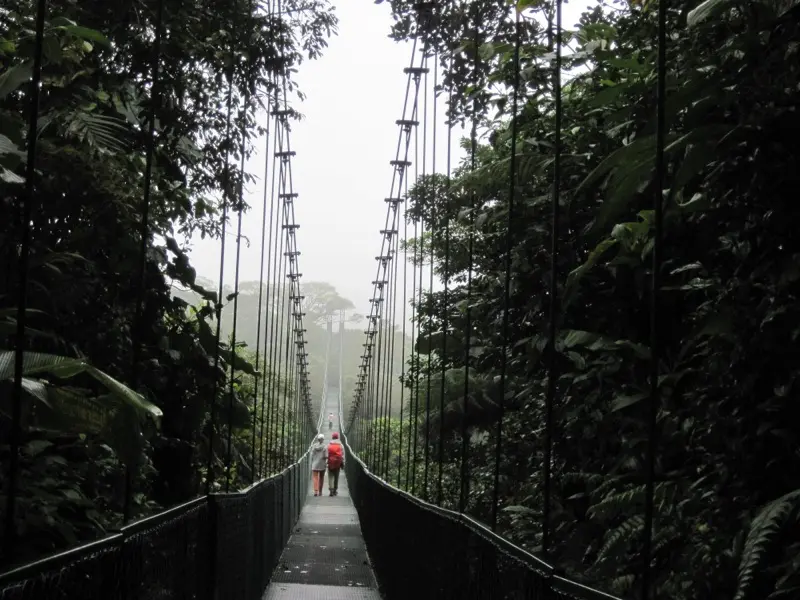
The cloud forests of Monteverde and the area around Arenal are strung with hanging bridges at canopy height: about as close as you can get to the famous bridge study, but this time with the person you came with. Further south, Luna Lodge in Carate sits next to Corcovado National Park on the Osa Peninsula, where walks into the park need an authorized guide. Up north, El Silencio Lodge & Spa in Bajos del Toro pairs waterfall trails with a spa.
Volcanoes: a hike, then hot water
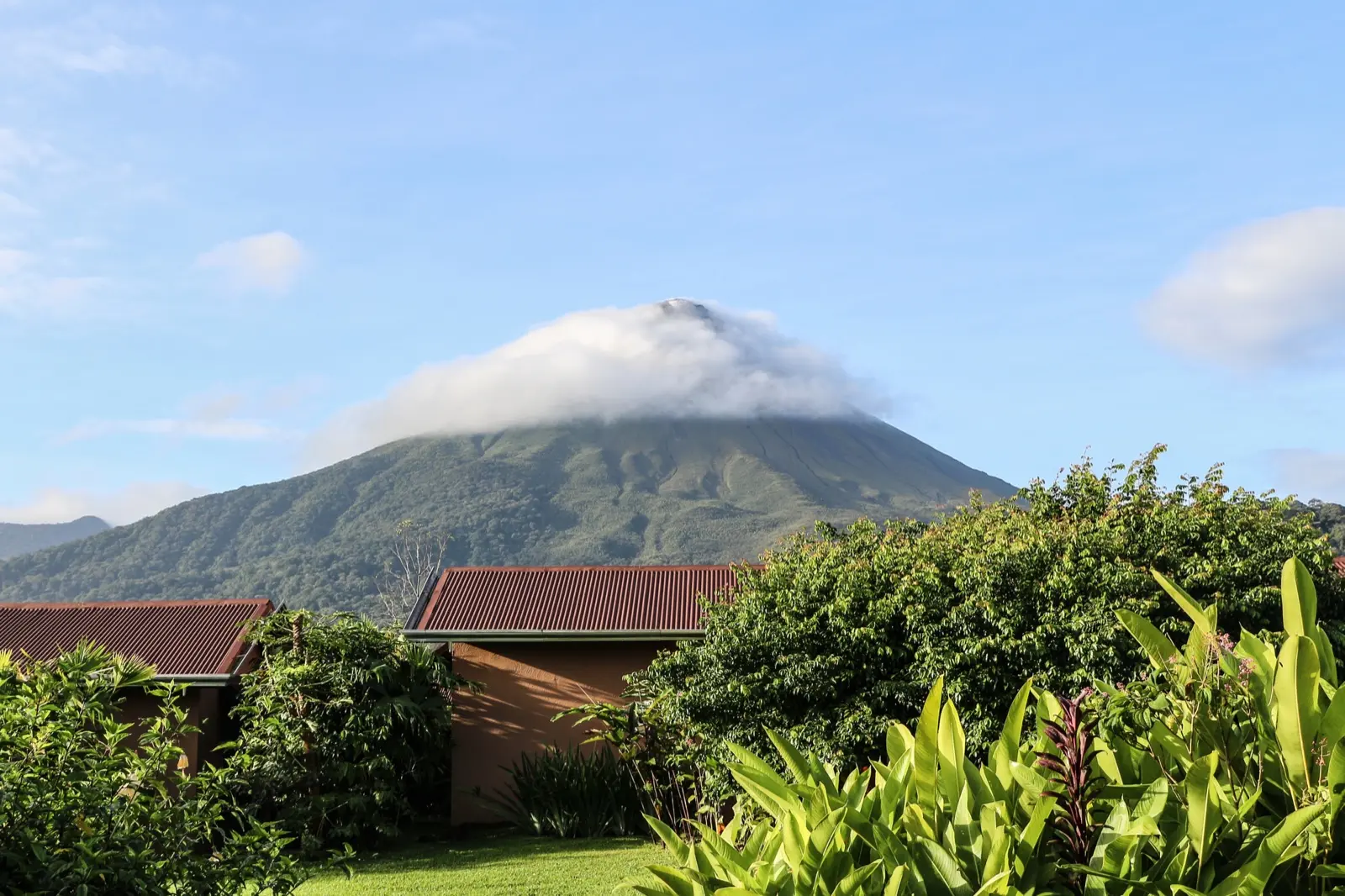
Arenal Volcano National Park, about 15 km from La Fortuna, has 4 named trails and the remains of old lava flows, according to Visit Costa Rica, the national tourism board. In Guanacaste, near Liberia, Rincón de la Vieja Volcano National Park has bubbling mud pots, fumaroles, waterfalls and hot springs on its trails (Visit Costa Rica). Rancho Margot, a farm with daily yoga on the far side of Lake Arenal, is a good base for Arenal's trails.
Rest, so the new things land
The studies tested short bursts of novelty, not a week of non-stop adrenaline. A good trip mixes the 2: something new in the morning, then yoga, a swim or a nap. At Anamaya above Montezuma, for example, yoga 6 mornings a week sits next to surf lessons and the town's waterfall. A teacher who led retreats in Montezuma described the same idea years ago:
"It’s not that you just come and do yoga with us but rather we experience yoga together in the rivers and ocean as well as in the studio."
Ireni Stamou, who ran Yoga Rica retreats around Montezuma, in a 2012 interview with The Tico Times
If you'd like a challenge you do on the mat, partner yoga and acroyoga give you the "we need each other" part in a very literal way.
Planning your own shared-novelty week
Pick 2 or 3 things neither of you has done, spread them across the week, and leave space between them. Then decide what kind of trip you want: our guide to choosing a couples retreat compares adventure, intimacy and counseling-style programs, and couples-specific retreats in Costa Rica lists the programs built for 2. If your partner needs convincing, read how to talk your partner into a couples retreat first.
Common questions
Do new experiences really bring couples closer?
Several studies suggest they do, at least in the short term. Couples who share exciting new activities report more satisfaction than couples who share only pleasant ones, though the effects are modest.
What is the self-expansion theory of relationships?
It's the idea, developed by Arthur and Elaine Aron, that people want to grow and broaden their lives, and that a partner who's linked to new experiences feels more rewarding to be with.
Does the suspension bridge study apply to couples?
Not directly. The 1974 study involved men meeting a stranger, and a 2012 reanalysis found statistical and design problems with it. The couples evidence comes from later studies.
How long does the effect of a new activity last?
Most studies measured it right away or over a few weeks. One trial found couples still scored higher 4 months after a 4-week program of exciting activities.
What counts as a "new and exciting" activity?
Something new to both of you and a little challenging: a surf lesson, a dance class, a hike you've never done. It doesn't need to be dangerous.